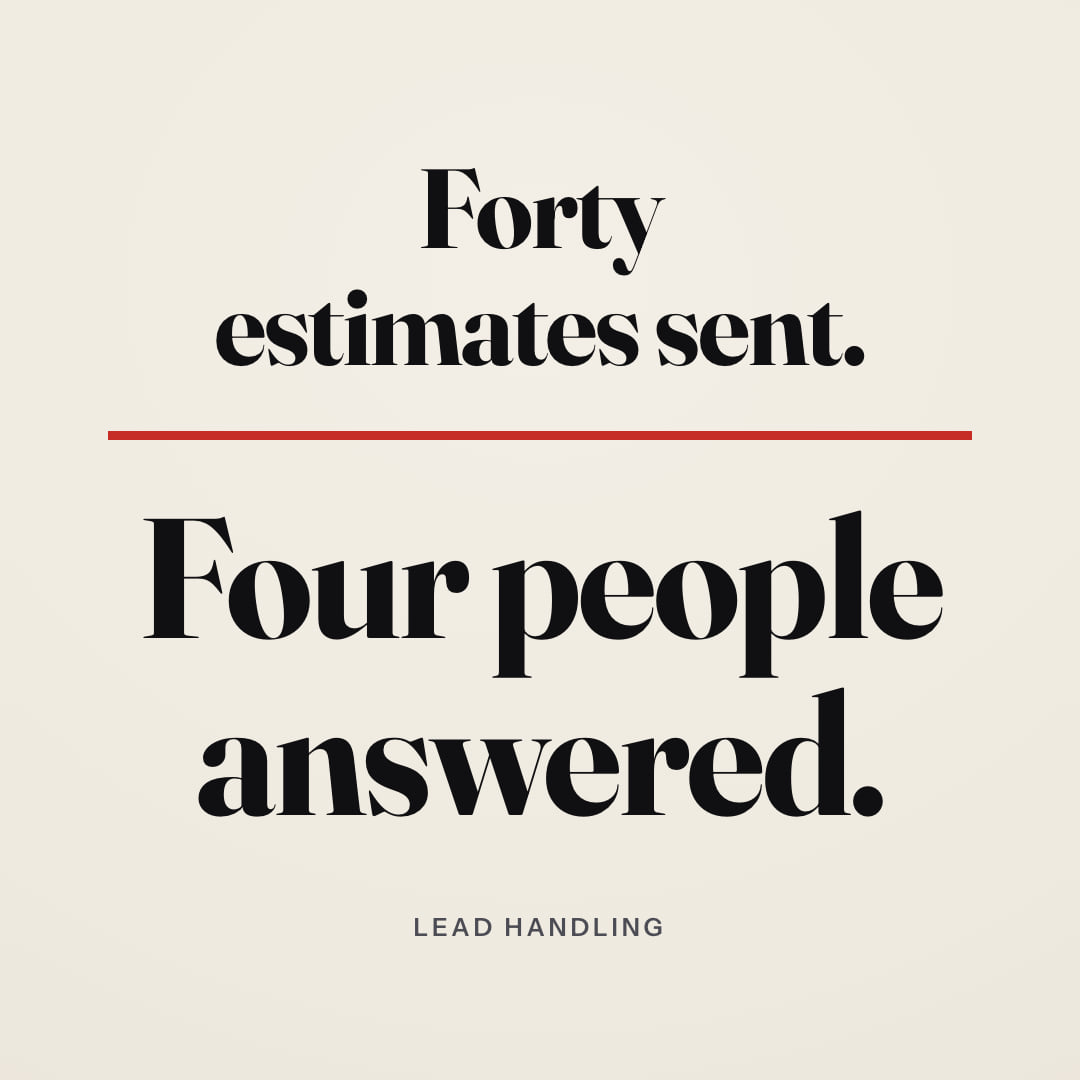
Forty estimates issued. Four responses.
That ratio is common in the flooring trade and it is almost universally misread by the businesses experiencing it.
The instinctive conclusion is that pricing is too high. In most cases the pricing is competitive. What has actually occurred is that the estimate was delivered to someone who was never a realistic buyer for that company, because the inquiry was sold simultaneously to several competitors, because no one established budget or timeline before the visit, or because the homeowner was assembling comparison numbers rather than picking a company.
The estimate did not lose on merit. It was never genuinely in contention.
Four ways a quote is dead before you write it
Three of these are in the paragraph above. The fourth is the one flooring owners are most surprised by.
- It was a shared inquiry. Five companies got the same form. Four of those calls are unsolicited from the homeowner’s side, and no amount of care in your write-up changes which one they were waiting for.
- Nobody qualified it. No budget, no timeline, no confirmation that the person you met can authorise the work. The visit went ahead on hope.
- They were collecting numbers. Some homeowners need three quotes for a decision that was already made, or for a landlord, or for an insurer.
- The quote arrived without a conversation. Sent by email into silence, two days after the visit, with nobody walking them through what is in it. A number alone is very easy to ignore, and it invites a comparison on the only axis it offers.
Only the fourth one is fully inside your control after the visit. The other three were decided before you knocked.
Do this with your own last forty
One evening. A sheet with five columns. It settles the argument faster than any opinion, including this one.
- List your last forty quotes. Date, source, job size, outcome, and whether anybody ever replied at all.
- Mark each source as shared or asked-for-by-name. Be honest about which of your sources is which.
- Mark whether budget and timeline were known before the visit. Not guessed. Known and written down.
- Mark whether you spoke to a human within an hour of the inquiry landing.
- Now count the response rate for each group separately.
The result is almost always the same shape. The quotes that came from qualified, quickly-answered, asked-for inquiries respond at a rate that looks like a different company. The rest are the graveyard, and they are dragging your average down to a number you then treat as your pricing.
Reading the number honestly
Bands, with reasoning, rather than a benchmark somebody invented. Where your own average sits tells you which problem you have.
| Quotes that get any reply | What that usually means | Where the fix belongs |
|---|---|---|
| Around one in ten | You are quoting people who never chose you | The top of the funnel, not the quote |
| Roughly a quarter | Mixed sources, and the shared ones dominate | Split your sources and treat them differently |
| Around half | Qualification is working, follow up is thin | The week after the quote goes out |
| Most of them | Your funnel is healthy. Now look at close rate | Pricing and the conversation in the room |
Why cutting the price makes it worse
This misdiagnosis is expensive because it prompts the wrong correction. The business reduces pricing, wins additional low-margin work, and becomes busier and less profitable at the same time, while the underlying problem, unqualified demand, is untouched.
The arithmetic is worth doing once, and what follows is an illustration rather than anybody’s real figures.
Take a job at ten thousand dollars where materials and labour cost you seven and a half. That is two and a half thousand left over. Cut the price by ten percent to win more of them and you are at nine thousand against the same seven and a half, so what is left has gone from two and a half to one and a half. You did not lose ten percent. You lost forty percent of what you actually keep.
To stand still you now need well over half again as many jobs, run by the same crew, on the same trucks. That is how a company ends up fully booked, exhausted, and unable to pay for a second van.
Where the correction belongs
Upstream, in four places, none of which are your price list.
- Speed. A person on the phone in minutes rather than hours, because on a shared inquiry the first real conversation usually takes the preference.
- Qualification. Budget, timeline, ownership and product, before the visit is booked rather than after it is attended.
- Source honesty. Know which of your inquiries are shared and stop measuring them against the ones that asked for you.
- Fewer, better visits. Every estimate you do not attend is half a working day back, and it goes straight into the ones that were real.
Make the quote harder to compare on price alone
Four documents on a table with four totals on them is a price contest, and a price contest is won by whoever left the most out. You cannot stop the comparison. You can decide what it compares.
- Scope in their words. Which rooms, what happens to the subfloor, where the old material goes, who moves the furniture. A homeowner cannot tell two quotes apart if both of them just say “supply and fit.”
- Exclusions, written down. This feels like it costs you the job. It is also the line people quote back to you approvingly when somebody else’s number moved halfway through.
- Dates. A start week and an honest duration. Availability beats a lower number more often than owners expect, particularly in a busy month.
- Two or three real options. Priced, genuinely different, and all of them something a person would actually buy. Not two decoys and an answer.
If you only change two things
Most flooring owners reading this will not rebuild their funnel next week. Fine. Two changes carry most of the effect and both are free.
First, get a person on the phone within minutes instead of hours. Not a better call. A faster one. On a shared inquiry that is worth more than everything else on this page put together, and it is not only our observation: Harvard Business Review's study of online sales leads reported that most companies are not responding nearly fast enough.
Second, ask about budget before the van is loaded. Give a range so they are choosing rather than confessing, and accept that you will lose some visits. Losing a visit costs you nothing. Attending it costs you half a day.
The follow up that recovers some of them
Not all forty are gone. The ones worth chasing are the ones who engaged and then went quiet, and there is a version of follow up that works on them.
Phone them the day the quote goes out and walk the number through. Ten minutes then beats four emails afterwards, because a quote explained is a conversation and a quote emailed is a price tag. After that, three or four contacts over two weeks, each carrying something real rather than asking again for a decision.
Then stop, and put them somewhere you will find them in six months. Some of those come back, and they cost you nothing to reach the second time.
What the number is telling you
A ten percent response rate is not a pricing signal. It is a qualification signal. The correction belongs at the top of the funnel, not at the quote.
The stage before this one, where the visit gets booked at all, is in the five most expensive words in flooring. The stage after it, in the room, is “I need to think about it” means you lost the estimate. And the number that prices the whole thing is cost per booked estimate.
If you want to see what the same argument looks like once it is somebody's job rather than an article, that is the work we do for flooring companies, and the jobs that came out of it are on the results page, each figure welded to the window it happened in.
Sources
- Harvard Business Review, The short life of online sales leads, Oldroyd, McElheran and Elkington, March 2011. Their summary of the research: most companies are not responding nearly fast enough.